







A garage door opener handles hundreds of cycles per year, and most problems develop gradually before causing complete failure. Knowing what each symptom points to saves time and prevents unnecessary service calls for issues you can resolve yourself. Some problems genuinely require a professional. This guide covers both clearly.
Our technicians at Easy Garage Door have diagnosed and repaired garage door opener problems across Houston for years, and they have reviewed this guide to ensure accuracy. For problems that DIY troubleshooting can’t address, our team handles garage door opener repair with same-day service throughout Houston.
Quick Diagnostic: Match Your Symptom to the Cause
| Symptom | Most Likely Cause | DIY or Pro |
| Door doesn’t respond to remote or wall button | Dead batteries, lost programming, power issue | DIY |
| Motor runs, but door doesn’t move | Disconnect switch engaged | DIY |
| Door opens but won’t close | Sensor misalignment or obstruction | DIY |
| Door reverses before or after hitting floor | Limit settings or sensor issue | DIY or Pro |
| Remote works but wall button doesn’t | Faulty wall switch or wiring | DIY or Pro |
| Opener is louder than usual | Loose hardware, worn drive, lack of lubrication | DIY |
| Door opens or closes slower than normal | Worn springs, rollers, or motor strain | Pro |
| Door opens randomly without input | Frequency interference or stuck remote button | DIY |
| Opener light flashes, but door won’t move | Sensor fault, lock mode, or motor issue | DIY or Pro |
1. Door Doesn’t Respond to Remote or Wall Button
The most common opener complaint and usually the simplest fix. Work through these in order before assuming the opener itself has failed.
Check first:
- Replace remote batteries (even if the LED still lights up, weak batteries fail to transmit signal)
- Verify the opener is plugged in and the outlet has power (test with another device)
- Check your home’s circuit breaker for a tripped garage circuit
- Confirm you’re within range (most remotes work up to 100 feet)
- Check the antenna wire hanging from the opener motor unit is fully extended and not coiled
If basic checks pass: Reprogram the remote using the Learn button on the opener motor unit. Power outages from Houston storms frequently erase remote programming. Press the Learn button, then press your remote button within 30 seconds until the opener light blinks, confirming successful programming.
If nothing works: The circuit board or motor may have failed. This requires professional diagnosis.
2. Motor Runs, But Door Doesn’t Move
The opener is working, but the door stays put. This almost always means the disconnect switch is engaged.
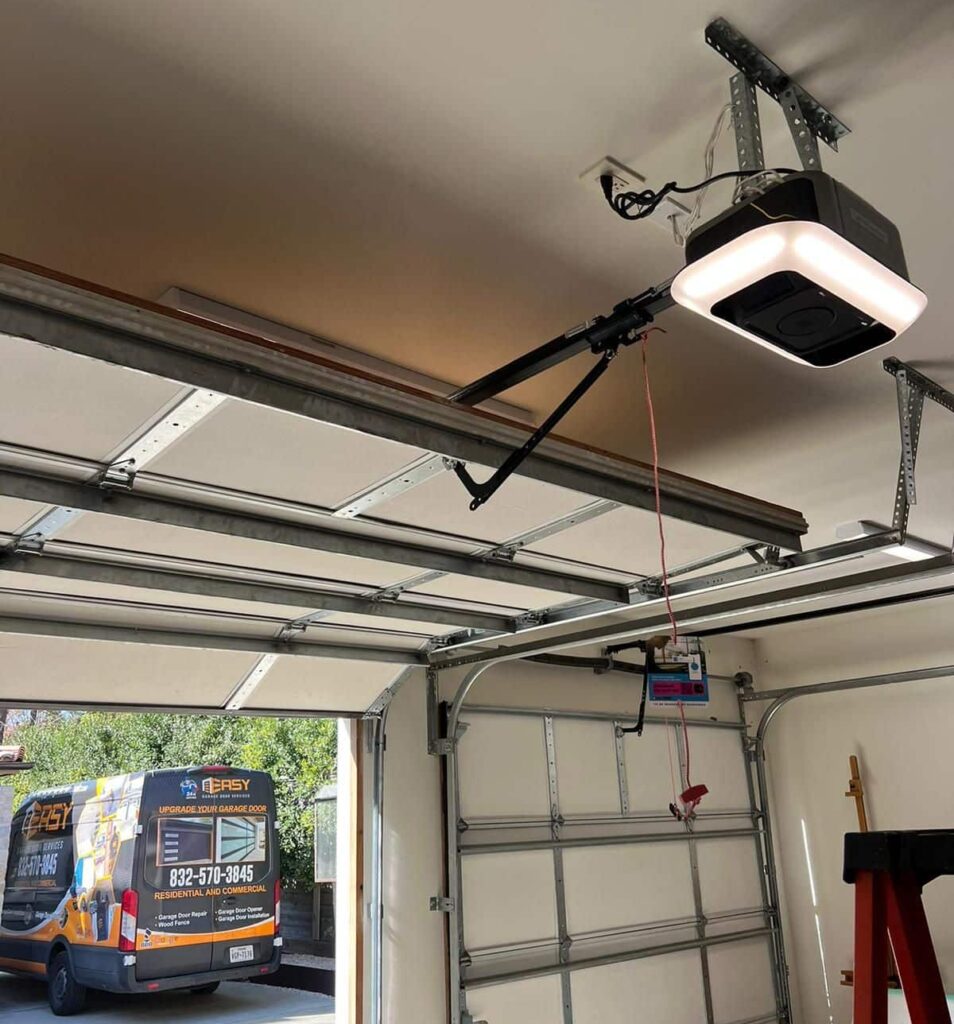
Every opener has a manual disconnect (the red emergency release cord) that disconnects the trolley from the drive mechanism for manual operation during power outages. If this was pulled recently and not reset, the opener runs its motor while the door stays disconnected.
Fix: Pull the emergency release cord toward the door rather than straight down. You’ll hear or feel a click when the trolley re-engages. Test the opener. If the trolley won’t re-engage, the carriage or trolley mechanism may be damaged, requiring professional repair.

3. Door Opens But Won’t Close
The door opens normally but reverses immediately when you try to close it. Safety sensors are almost always responsible.
Safety sensors sit 4 to 6 inches above the floor on each side of the door. When the infrared beam between them is blocked or misaligned, the opener interprets it as an obstruction and prevents closing. In Houston garages, spider webs blocking the sensor beam are the single most common cause.
Fix:
- Remove any objects from the doorway
- Wipe both sensor lenses with a dry cloth, removing dust, spider webs, and moisture
- Check that both sensor LEDs show solid lights (one green, one amber)
- If the amber LED blinks, loosen mounting screws on one sensor and adjust until both LEDs show solid, then retighten
If the door closes when you hold the wall button down continuously but not on a single press, sensors are detecting a false obstruction. This override mode confirms sensors are the issue.
4. Door Reverses Before or After Hitting the Floor
The door almost closes then immediately reverses back up, or closes, touches the floor briefly, then reverses.
Closes then reverses before floor: Close-limit setting is telling the opener the door has traveled far enough before it actually has. Locate the limit adjustment screws on your opener motor unit (labeled “down” or “close”). Turn in small quarter-turn increments and test after each adjustment.
Touches floor then immediately reverses: The down-limit is set too far, causing the motor to interpret the floor contact as hitting an obstruction. Same adjustment, opposite direction.
Safety note: The auto-reverse feature is a required safety mechanism. If the door doesn’t reverse when you press down on it with 20 pounds of resistance during closing, the force setting needs adjustment. This is a safety fault requiring immediate attention.
5. Remote Works But Wall Button Doesn’t
The door responds to your remote but pressing the wall button does nothing.
This isolates the problem to the wall button circuit rather than the opener itself. Try replacing the wall button first (they cost $15 to $30 at hardware stores and plug into the same terminals). If a new button also doesn’t work, the wiring between the button and opener has a fault. Check the wire terminals at both the button and the opener for loose or corroded connections.
Wall button wiring runs along the garage wall and ceiling and can be damaged by staples, nails, or pests chewing through the insulation. Damaged wiring requires rerunning the wire or splicing the damaged section. If you’re not comfortable with basic electrical work, this is a professional repair.
6. Opener Is Louder Than Usual
An opener that suddenly gets louder is signaling a maintenance need before a mechanical failure.
Chain drive openers: Loose chain is the most common cause. The chain should have slight sag (about 1/2 inch) but not be loose enough to slap against the rail. Tighten using the adjustment hardware on the trolley. Apply white lithium grease to the chain if it hasn’t been lubricated recently.
Belt drive openers: A slapping or vibrating noise indicates belt tension loss or belt wear. Belt drives are quieter than chains, and increased noise is a clear signal that something changed. Inspect the belt for fraying or cracking.
All opener types: Tighten all mounting hardware (brackets, carriage bolts, rail connections). Houston’s frequent door cycles loosen hardware gradually, and vibration noise from loose components is common. Lubricate hinges, rollers, and springs with silicone-based spray during the same service visit.
7. Door Opens or Closes Slower Than Normal
Noticeable slowdown in door speed is rarely an opener problem. The opener isn’t struggling more; the door is harder to move.
The most common causes are worn or dirty rollers creating friction, springs losing tension making the door heavier to lift, and track buildup slowing roller movement. All of these add resistance the opener motor has to overcome, making operation appear slower.
What you can check: Clean and lubricate rollers and tracks. Test door balance by disconnecting the opener and lifting the door manually to waist height. A balanced door stays in place when released. A door that falls is spring-related and requires professional spring adjustment.
Spring work carries serious injury risk from the 200 to 400 pounds of tension involved. If the balance test reveals a spring issue, contact our team for garage door repair in Houston rather than attempting adjustment yourself.
8. Door Opens Randomly Without Input
The door activates on its own without anyone pressing a remote or button. This is disorienting but usually has a simple explanation.
Most common causes:
Frequency interference from a neighbor’s opener, a nearby business’s radio equipment, or even some LED light bulbs operating on similar frequencies can trigger your opener. This is more common in Houston’s densely populated neighborhoods where many openers operate in proximity.
A stuck remote button in a vehicle, drawer, or bag continuously transmitting a signal also causes random activation. Check all remotes associated with the door.
Fix: Clear your opener’s memory by pressing and holding the Learn button for 6 to 10 seconds until the indicator light goes off. This erases all programmed remotes. Reprogram only the remotes you currently use. If random activation continues after clearing memory, the logic board is receiving phantom signals and may need replacement.
9. Opener Light Flashes, But Door Won’t Move
Flashing lights on your opener communicate specific error codes through blink counts. Count the flashes before troubleshooting.
| Blinks (LiftMaster/Chamberlain) | Cause |
| 1 blink | Sensor wire open or disconnected |
| 2 blinks | Sensor wire shorted or reversed |
| 4 blinks | Safety sensors misaligned |
| 5 blinks | Motor overheating or RPM sensor failure |
| 6 blinks | Motor circuit failure |
| Continuous blinking | Safety lock or vacation mode engaged |
For a full breakdown of LiftMaster error codes and troubleshooting, see our LiftMaster opener repair page. We’re an authorized LiftMaster dealer in Houston.
For Genie openers, blink codes differ by model. Consult your opener’s manual or the manufacturer’s website for model-specific codes.
Safety lock mode (continuous blinking) is worth checking first, as it’s often engaged accidentally. Press and hold the lock button on your wall panel for 2 to 3 seconds to disengage.
Specific Opener Problems in Houston
Power outages erase remote programming. Houston’s frequent storms cause power outages that reset opener logic boards, erasing all programmed remotes. If your remote stopped working after a storm, reprogramming is almost always the solution before any other diagnosis.
Heat causes opener motor shutdowns. Garages in Houston regularly reach 110 to 130°F in summer. Opener motors have built-in thermal protection that shuts down when overheated. If your opener stops mid-cycle on a hot day and works again 15 to 30 minutes later, heat is the cause. Improving garage ventilation or adding attic insulation above the garage reduces peak temperatures.
Never plug your opener into an extension cord. Extension cords create a voltage drop that prevents the motor from drawing full power, causing sluggish operation, overheating, and premature motor failure. If the outlet near your opener isn’t convenient, have a properly rated outlet installed rather than using an extension cord.
When to Call a Professional
DIY-safe troubleshooting: Battery replacement, remote reprogramming, sensor cleaning and alignment, wall button replacement, disconnect switch re-engagement, limit setting adjustment, chain lubrication.
Requires professional service: Motor or circuit board failure, wiring repairs, spring-related slowness, trolley or carriage damage, repeated thermal shutdowns suggesting structural motor issues, and any opener 15+ years old showing multiple symptoms simultaneously.
Our technicians at Easy Garage Door diagnose opener problems accurately on the first visit and carry common replacement parts on service vehicles. Contact us for same-day service throughout Houston and surrounding areas.
Frequently Asked Questions
How do I know if my opener needs repair or full replacement?
Repair makes sense for most individual component failures, including sensors, logic boards, gears, and remotes, when the opener is under 15 years old. Full replacement makes more sense when the opener is 15 or more years old and experiencing multiple problems, when repair cost approaches 50% of replacement cost, or when the opener lacks modern safety features like auto-reverse and photo-eye sensors. Openers manufactured before 1993 lack federally required safety features and should be replaced regardless of operating condition.
Can a power surge damage my garage door opener?
Yes. Houston’s frequent thunderstorms cause power surges that damage opener logic boards even when the opener isn’t actively in use. A surge protector on the outlet prevents most surge-related damage. If your opener started behaving erratically immediately after a storm, surge damage to the logic board is a likely cause. Logic board replacement costs $75 to $150 for the part plus labor versus full opener replacement at $300 to $800 installed.
Why does my garage door opener work from close range but not from the driveway?
Limited range indicates weak remote batteries, a damaged antenna wire on the opener motor unit, or radio frequency interference in your area. Replace batteries first. Then check that the antenna wire (6 to 12 inches long, hanging from the motor unit) is fully extended and not coiled or touching metal surfaces. Metal contact grounds the antenna signal and dramatically reduces range. If range problems persist after both fixes, the receiver board inside the opener may be failing.
How long do garage door openers last in Houston?
Most residential garage door openers last 10 to 15 years with normal use and basic maintenance. Houston’s heat accelerates motor wear and electronic component degradation compared to cooler climates. Annual garage door maintenance, including opener inspection, lubrication, and force setting calibration, extends opener lifespan and catches early warning signs before complete failure.

