








A garage door that sags in the middle usually has a top section that was never reinforced, worn center hinges, or tracks that have pulled loose from the ceiling. Less often, the cause is a spring or cable problem, damage from an impact, or a header above the opening that has started to drop. Most cases are fixed with a steel strut or new hardware. Spring, cable, and structural problems need a technician.
You usually notice the sag when the door is open. The sections lie flat overhead and are held only at the ends by the rollers. Nothing supports the middle, so a weak or unreinforced section bows under its own weight. You may also see the door catch or shudder as it rolls over the curve of the track.
Houston homes tend to run into this sooner. Many have 16-foot double doors, which leave a long span with nothing supporting the middle. Houston’s clay soil also swells when it is wet and shrinks when it dries, which can shift slabs and framing over the years.
Reviewed by the Easy Garage Door technician team, based on sagging door repairs across the Houston area.
Find Your Type of Sag First
Look at the door open and closed before you buy anything. Where the sag shows up tells you which cause you are dealing with and who should fix it.
| What you see | Most likely cause | Who fixes it |
| Door dips in the middle when open | Missing strut, thin door or worn hinges (causes 1 to 3) | Often a homeowner, with care |
| Open door sits low toward the back, tracks look uneven | Loose track hangers (cause 4) | Technician recommended |
| Door lifts or hangs crooked, one side lower | Cable or spring problem (cause 5) | Technician only |
| One section is bent or cracked | Impact damage (cause 6) | Technician |
| Opening dips, brick cracked above, top of door rubs at the center | Header above the door (cause 7) | Structural contractor first |
7 Causes of a Garage Door Sagging in the Middle
1. No Reinforcement Strut on the Top Section
Your opener pulls the whole door from one bracket at the top center. Without a steel strut across that section to spread the force, the metal bends where the opener arm attaches. LiftMaster’s installation instructions say lightweight steel, aluminum, fiberglass, and glass panel doors need the top section reinforced before the opener bracket goes on. Over time, an unreinforced top section bows, and the bow spreads to the sections below.
The fix: a full-width strut on the top section, with the opener bracket mounted on or just below it.

2. A Thin or Lightweight Door
Builder-grade doors often use thinner steel and have little inside the sections to stiffen them, so they flex on every cycle. We see this often in newer neighborhoods where whole streets were built with the same basic door, including many of our calls for garage door repair in Cypress.
The fix: struts on the sections that bow. If several sections are badly bowed or cracked, a stronger door is often the better value. When comparing doors, a lower gauge number means thicker steel.
3. Worn or Loose Center Hinges
Center hinges hold the sections in line with each other. After thousands of cycles, the screw holes widen and the hinges wear, so the sections tilt out of line instead of staying flat. You often hear this before you see it, as a pop or a knock when the door changes direction.
The fix: replace worn hinges one at a time with hinges of the same number. Where a screw hole is stripped, use a slightly larger self-tapping screw or a stile repair plate.
4. Sagging Horizontal Tracks
Sometimes the door is fine, and the tracks are not. The horizontal tracks hang from the ceiling on rear brackets called hangers. If a hanger loosens or bends, the track drops and the open door sags with it. Open the door and check whether both tracks are level and the hangers are tight.
The fix: tighten or replace the hangers and level the tracks. The tracks carry the full weight of the open door, so this is safer with a technician.

5. Spring or Cable Problems
The springs carry the weight of the door, and the cables lift both bottom corners. A slack or fraying cable, or a drum that has slipped, makes the door lift crooked with one side lower. On doors with extension springs along the tracks, a weak spring on one side does the same. On doors with a torsion spring above the opening, both cable drums turn on one shaft, so a weak spring makes the door heavy rather than crooked.
Either way, the opener ends up lifting more weight from that one center bracket, which bends the top section. A broken spring can bend a thin section in a single cycle.
The fix: technician only. Springs are replaced in pairs, worn cables are replaced, and the door is rebalanced.
6. Impact Damage
A car bump can leave a dent that looks cosmetic, but the steel has been stretched and weakened. A hairline crack can appear weeks later and grow with every cycle, until the section catches on the curve of the track.
The fix: replace the damaged section if the part is still made. Some builder-grade models are discontinued after a few years, so have the door model identified before you count on a section swap.
7. The Header Above the Opening Is Dropping
Sometimes the door is not the problem at all. Three signs point to the structure instead:
- The top of the opening dips in the middle
- Stair-step cracks show in the brick above the door
- The gap between the top of the closed door and the header is tighter at the center than at the ends, or the top section rubs there
An undersized steel lintel under brick can cause this, and so can a header that is too weak for a wide opening. Houston’s shifting clay soil can make it worse.
The fix: a structural contractor first. A new door hung in an opening that is still moving will have the same problem again.
How to Fix a Sagging Garage Door
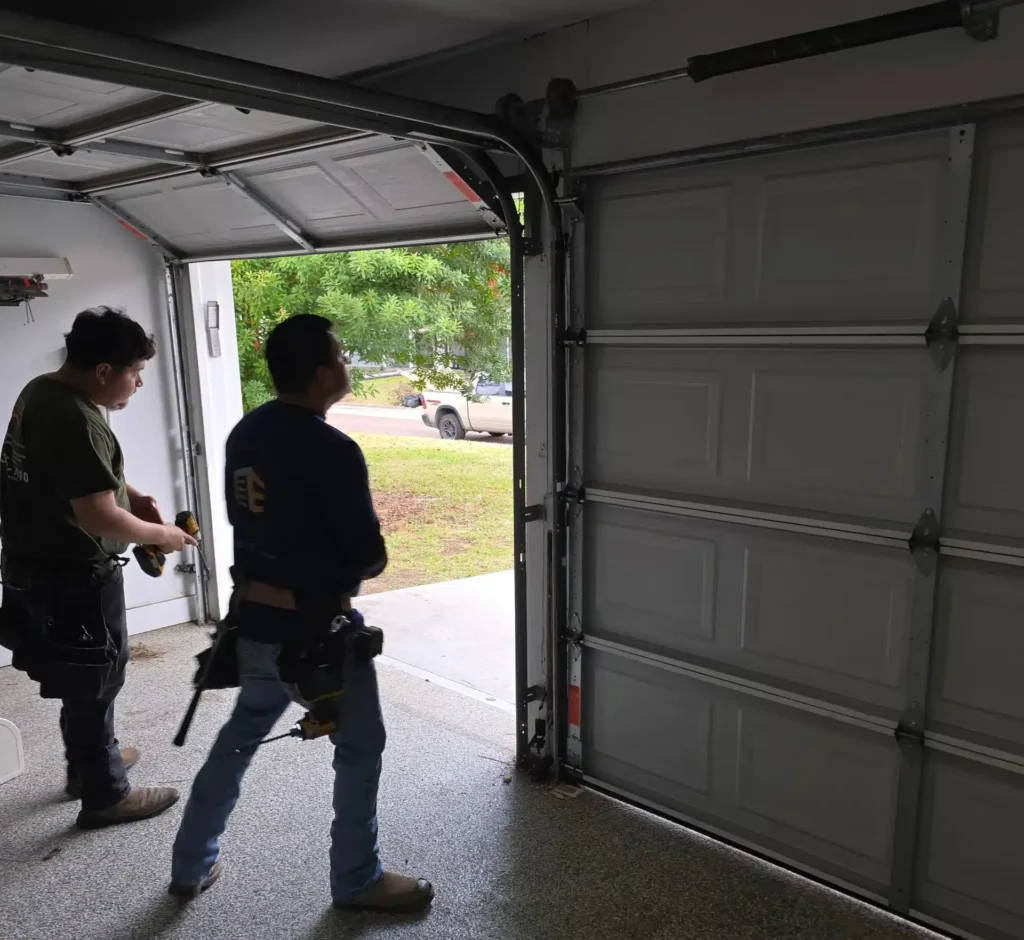
Adding a strut and replacing worn center hinges are reasonable jobs for a handy homeowner. Anything involving springs, cables, tracks, or the opener bracket should be done by a technician. Start with the checks below to find out which side of that line your door is on.
Check These First
These four checks cost nothing and tell you whether this is a job for you or for a technician.
- Test the balance. With the door fully closed, pull the emergency release cord. Lift the door to about waist height and let go. A balanced door stays put. If it drops, rises or feels very heavy, stop and call a technician. Reconnect the opener when you are done.
- Look at the tracks and the opening. Check that the tracks are level and the hangers are tight (cause 4), and look for the header signs above (cause 7).
- Watch the cables. Lift the door by hand and see if one side leads the other, or if one cable looks slack or frayed (cause 5).
- Find the bowed section. Sight along the door with a flashlight, mark the section that bows, and check its inside face for hairline cracks, usually near the center.
If checks 1, 2, or 3 find a problem, call a technician before doing anything else.
Repairs a Handy Homeowner Can Do
- Replace worn center hinges. Keep the door closed and change one hinge at a time. Never loosen the bottom brackets at the lower corners, because they are under cable tension.
- Add a strut. Buy one that spans the full width of the section and reaches the end stiles on both sides, where the rollers sit. Fasten it to the inside face at every stile. A short piece bolted only across the middle does not help.
- Recheck clearance and balance. The strut adds thickness, so make sure it clears the header and track. It also adds weight. Repeat the balance test, and if the door no longer stays at waist height, the springs need adjusting by a technician.
Leave These to Garage Door Experts
- Spring or cable repair or adjustment. A torsion spring stores enough energy to cause serious injury if it releases without control.
- Track hanger repair and track leveling.
- Moving the opener bracket. LiftMaster’s instructions place the header bracket on a line 2 inches above the highest point of the door’s travel, fastened to solid framing, not drywall. The force settings need to be reset afterward.
- Replacing a cracked section.
Check the Opener After the Repair
Pulling a bowed or unbalanced door strains the opener’s motor and gears on every trip, so the opener can take damage while the sag is there. Once the door is fixed, listen for grinding, watch for a motor that keeps running after the door stops, and check that the door closes evenly. Any of these means the opener needs a check, and our garage door opener repair service covers that.
Quick Fixes That Make It Worse
- Propping the center with scrap wood or a short piece of metal. It adds weight where the door is already failing.
- Mounting reinforcement on the outside face. The door then catches on the opening as it moves.
- Skipping the reinforcement the door maker requires. LiftMaster notes that failing to reinforce the top section as the door manufacturer requires may void the door warranty.
Is It Safe to Use a Sagging Garage Door?
A mild sag with no crack is usually safe to use while you schedule the repair, though every cycle works the metal a little more. Stop using the door if the sag appeared suddenly, a section catches on the curve of the track, the door lifts crooked, or a spring looks broken.
Repair or Replace a Sagging Garage Door?
Most sags caught early are fixed with a strut or new hinges. If several sections are cracked, or the parts for your model are no longer made, a new door is often the better value.
Get a Sagging Garage Door Checked in Houston
The costly mistake with a sagging door is paying for the wrong repair. A strut on a section that has just started to bow is a short job. An opening that has moved needs the structure fixed first.
Call Easy Garage Door Repair at (832) 570-3845 to have your sagging garage door checked and repaired. We serve Houston, League City, Sugar Land, Katy, The Woodlands, Pearland, Conroe, Spring, Humble, and nearby communities. You can also request a free quote online, and our technicians will tell you which of the seven causes you are dealing with before any work starts.

