







A garage door that opens on its own, even occasionally, is not a random malfunction. It is the opener responding to a signal it should not have received, and there are only a limited number of ways that signal can be generated without a remote or wall button being pressed.
Identifying the cause is usually straightforward once the possibilities are narrowed down, and most causes fall into a small set of categories: a stuck control, a wiring fault, storm-related electrical damage, or an issue with a connected smart opener app.
Our technicians have reviewed this guide before publishing, and it reflects what our technicians see on service calls across the Houston area, not general manufacturer guidance.
What to Do When Garage Door Opens on its Own
If it’s only happened occasionally, you don’t need to treat it as an emergency. A few things are worth doing the next time you notice it:
- Check the time it happened against anything else going on, a storm, a power blip, a day you were near the garage with a bag or remote nearby. That context often points straight to the cause.
- If it happens repeatedly in a short window, or you’re leaving the house for a while, unplug the opener or pull the manual release cord and secure the door by hand until you’ve worked through the causes below. This isn’t necessary for a one-off event, but it matters if the door is actively cycling.
Reasons Why Garage Door Opens on Its Own
- Remote and Wall Button Problems
The most common cause by far is a stuck or failing button, either on a handheld remote or the wall-mounted control inside the garage. A button that’s physically stuck down sends a continuous signal, and the door reacts as if someone were pressing it.
This also happens when a remote is stored somewhere it can get pressed by accident: a bag, a glovebox, a drawer with other items shifting on top of it.
To check this, pull the batteries from every remote in the house and see if the openings stop. If they do, you’ve found it. A worn or failing remote is inexpensive to replace, and a stuck wall button can often be cleaned or replaced without a technician.
- Signal and Frequency Problems
Older garage door openers, generally anything installed before the early 1990s, used a fixed code set with small positioning switches. On these systems, it’s possible, though not common, for a nearby opener using the same code to trigger your door.
Modern openers use a rolling code that changes with every use, which makes this essentially a non-issue on anything installed in the last two decades. If your opener is older and you suspect this, the simplest test is to watch your door while a neighbor operates theirs.
- Wiring and Electrical Problems
The wires connecting the wall console, the motor unit, and the safety sensors carry low-voltage signals. If any of these wires are frayed, pinched, or chewed, they can send an intermittent false signal that behaves exactly like a button press.
Signs this is the cause include openings that happen at random times with no pattern, flickering lights on the opener itself, or any burning smell near the motor. Wiring issues are not something to open up and inspect yourself. This requires a technician.
- Control Board Failures and Power Surges
Most openers are built to last 10 to 20 years. As the control board ages, it can begin issuing commands without a clear trigger. This tends to show up alongside other odd behavior rather than as a single clean event, flickering lights, occasional unresponsiveness, or other erratic timing.
A power surge from a lightning strike or an outage can cause the same kind of damage suddenly rather than gradually. If the door started opening on its own right after a storm or a power interruption, this is the most likely explanation.
- Smart Opener and App Issues
If your opener connects to an app, such as LiftMaster’s MyQ platform, a few things unrelated to the physical hardware can trigger it. An old schedule or automation left active in the app, a firmware update that didn’t finish cleanly, or a shared household account with a schedule someone else set up can all send a command the same way a button press would.
Before assuming a hardware problem, it’s worth checking the app itself for any scheduled actions or automations that may still be active.

Why This Is Common in Houston
Our technicians see this issue more often in certain conditions, and Houston has several of them. Humidity is a major factor. Constant moisture in the air affects wiring connections and circuit boards over time, especially in garages that aren’t climate-controlled, which is most of them. This shows up more in older homes and in neighborhoods with mature tree cover, where garages also see more rodent activity, another common cause of chewed wiring.
Storm season adds the electrical surge factor on top of that. Houston gets frequent lightning activity and periodic power interruptions during severe weather, and we consistently see a rise in service calls for erratic opener behavior in the days following a storm.
We see this pattern across our service area, including Sugar Land, Cypress, The Woodlands, and Pearland, most often in homes with openers that are approaching or past the ten-year mark, where age, humidity, and storm exposure tend to combine.
What It Typically Costs to Fix
| Cause | DIY fixable | Typical professional cost |
| Stuck or failing remote button | Yes, replace remote or batteries | N/A |
| Stuck wall button | Sometimes, cleaning helps | $75 to $150 if a visit is needed |
| Frequency or signal interference | Rarely, usually needs reprogramming | $75 to $150 |
| Damaged wiring | No | $100 to $250 |
| Control board replacement | No | $150 to $450 |
| Surge or storm damage | No | $150 to $450 depending on extent |
| Smart opener app or automation issue | Yes, check the app settings | N/A |
These are directional ranges based on jobs our technicians commonly handle in the Houston area, not fixed quotes. Call 832 570 3845 for pricing specific to your situation.
When to Call a Professional
- You’ve ruled out remotes and wall buttons and it’s still happening.
- There’s any sign of wiring damage, flickering lights, or a burning smell.
- It started right after a storm or power outage.
- It’s begun happening more frequently rather than as an occasional event.
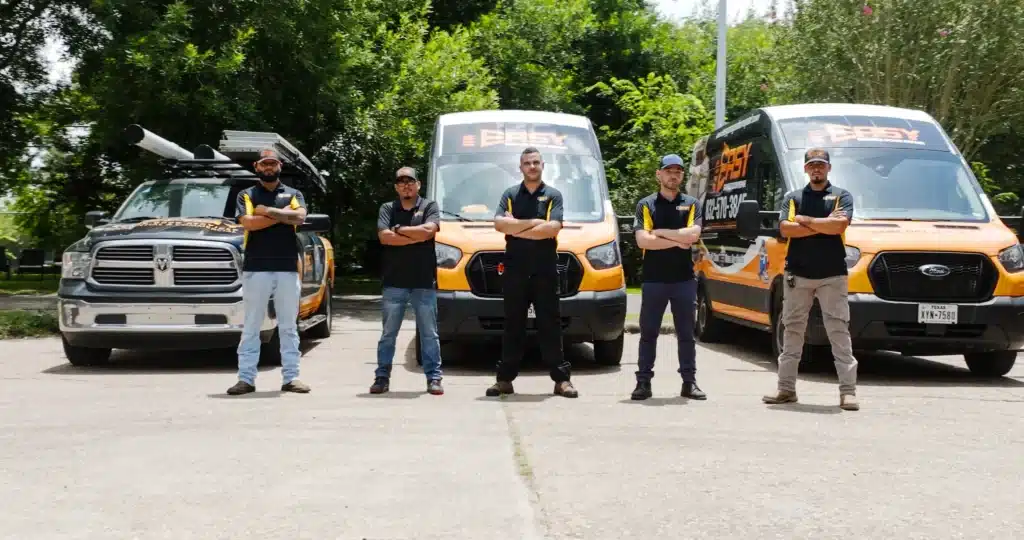
A door that opens without you is a security matter as much as a mechanical one. Easy Garage Door Repair technicians serve the Houston area, including Sugar Land, Cypress, The Woodlands, Pearland, and surrounding areas. Call us at 832 570 3845. We have same-day service and will be at your place within hours.
Frequently Asked Questions
Can a neighbor’s remote really open my garage door?
It’s possible on older openers that use a fixed code, but rare on anything modern with a rolling code. Watching your door when a neighbor uses theirs is the easiest way to confirm it.
Is an occasional false opening a security risk I need to worry about right away?
It’s worth taking seriously even if it’s infrequent, since it means something in the system can bypass your control. It doesn’t require an emergency call for a single occurrence, but repeated instances should be looked at.
Will resetting the opener fix it?
It can, if the cause is a temporary glitch in the app or firmware. It won’t fix a failing control board, damaged wiring, or a stuck button, so if it comes back after a reset, the cause needs a closer look.
Can my smart opener app open the door without me touching anything?
Yes. A leftover schedule, an old automation, or a shared account can all trigger the door the same way a remote would. Checking the app is one of the first things to try.
How do I know if it’s electrical rather than the remote?
Electrical causes tend to come with other signs, such as flickering lights, a burning smell, or timing that lines up with a storm or power interruption. A remote issue is usually isolated to the door alone with no other symptoms.


